
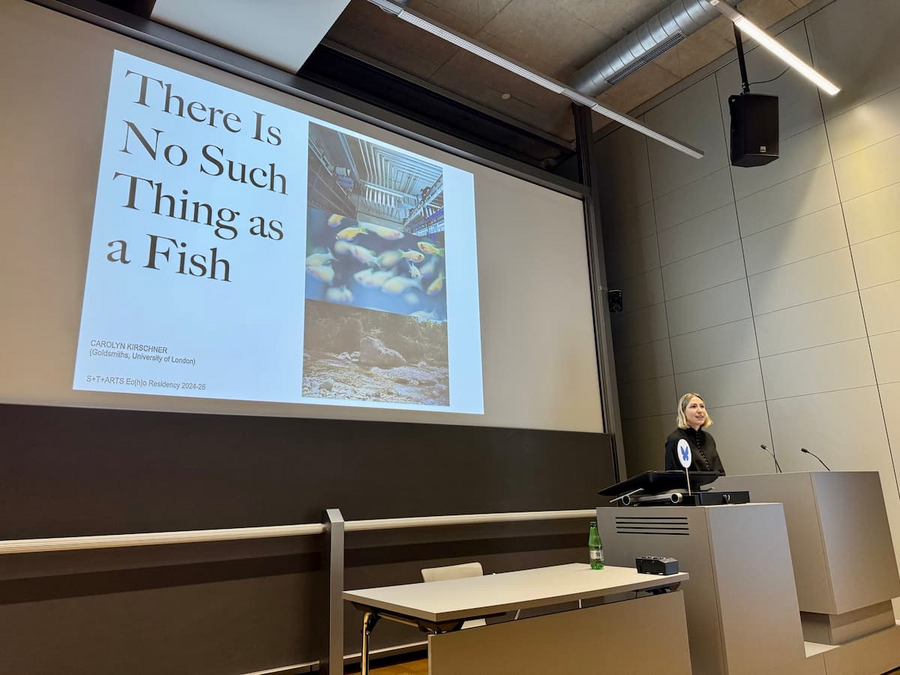
Carolyn Kirschner presents her film, "There is no such thing as a fish" © Katrin Boes / MPI-CBG
A recent science and art project features a film connecting biology with physics. Carolyn Kirschner worked together with Dresden research institutes to create a film that explores the scientific, cultural, and social significance of the zebrafish. Carolyn, a lecturer at Goldsmiths, University of London, is an S=T+ARTS Ec(h)o artist in residence hosted at the Office for Academic Heritage, Scientific and Art Collections (Kustodie) of TUD Dresden University of Technology. For her film she worked together with the Cluster of Excellence Physics of Life at TU Dresden, the Max Planck Institute of Molecular Cell Biology and Genetics Dresden (MPI-CBG), and the Chair of Neuronal Development and Regeneration at the Center for Regenerative Therapies Dresden (CRTD).
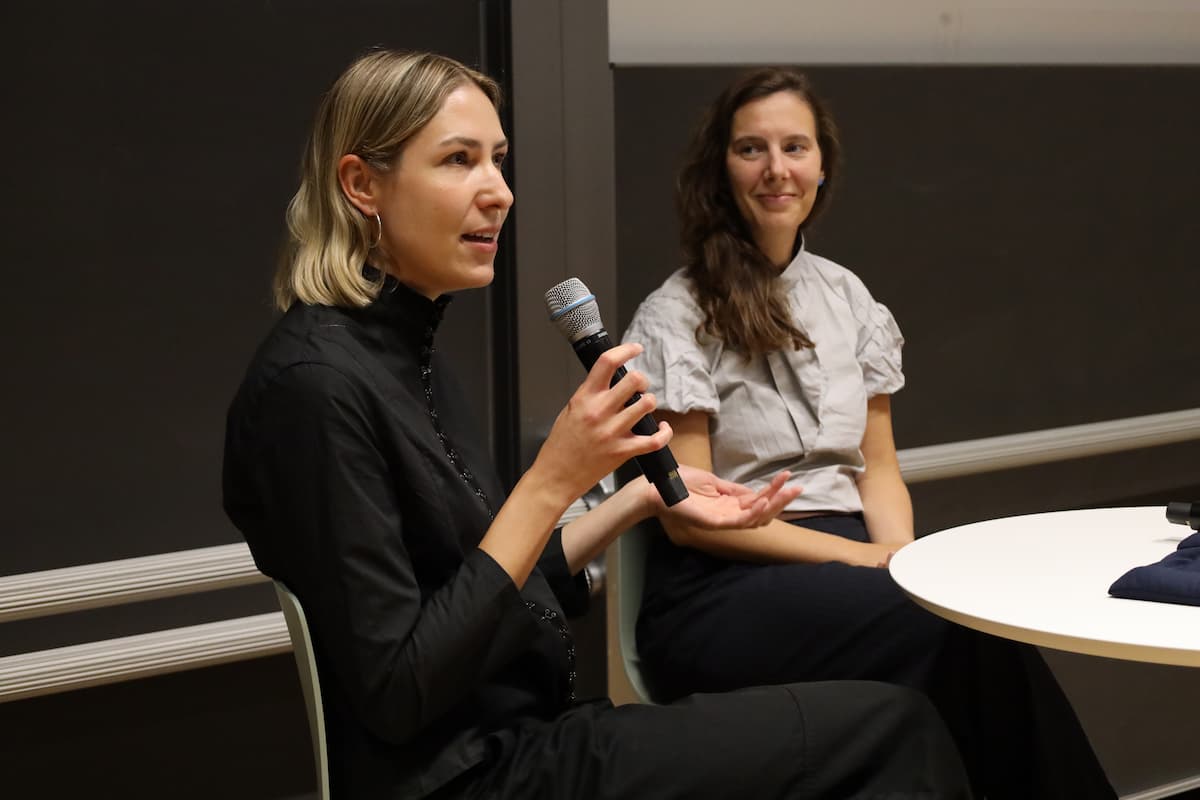
Carolyn Kirschner (left) and Rita Mateus (right) discuss the film. © Kostas Margitudis / MPI-CBG
The film was screened at MPI-CBG on September 15th, followed by a discussion with Carolyn Kirschner and Rita Mateus, a research group leader at MPI-CBG and the Cluster of Excellence Physics of Life (PoL). Kirschner's film follows the zebrafish through various locations - from research labs to pet shops, server rooms, and its natural habitat in India - bringing artistic inquiry into dialogue with perspectives from "Physics of Life" research. At MPI-CBG, Carolyn worked together with Rita Mateus, Ivo Sbalzarini, and Sebastian Bundschuh.
S+T+ARTS (Science, Technology, and Arts), an initiative of the European Commission that promotes exchange and collaboration between arts, science, and technology.
The film is part of the exhibition “Thinking. Together. Who is actually part of the research” in the COSMO Science Forum in Dresden from September 15 to November 26, 2026: https://www.cosmo-wissenschaftsforum.de/
S+T+ARTS Ec(h)o Residency of Carolyn Kirschner: https://tu-dresden.de/kustodie/projekte/art-science-1/s-t-arts-echo-residency/carolyn-kirschner?set_language=en