
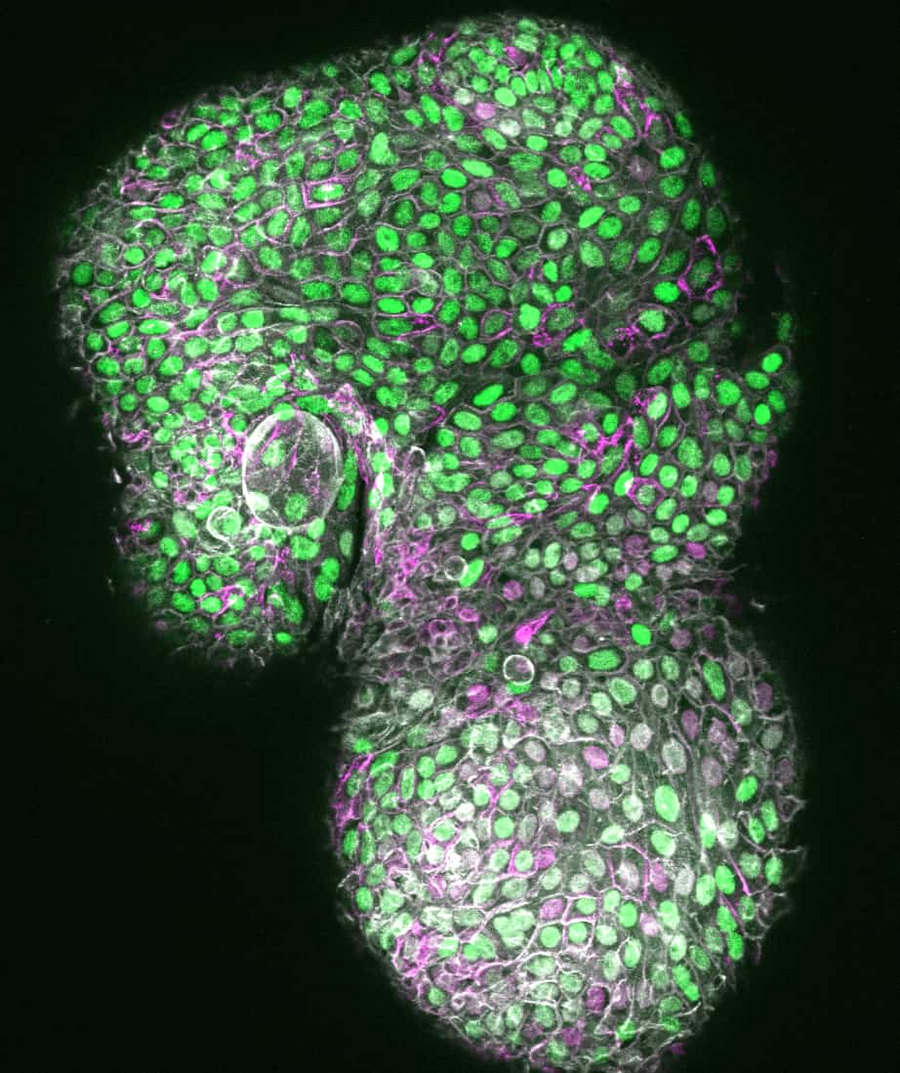
Liver ductal organoids grown in the "refined" medium display both cholangiocyte-fated (green) and hepatocyte-fated (magenta) cell populations. © Javier Bregante, Flaminia Kaluthantrige Don et al. Cell Reports, 2026 / MPI-CBG
Organoids are three-dimensional models of organs and closely simulate the organ in a living organism. As a result, they form a powerful experimental system, useful for understanding both development and disease mechanisms. Currently, organoids have been generated for almost all organs across multiple species and have resulted in over 20,000 scientific articles in the last decade.
A major part of the human liver is composed of two cell types, namely hepatocytes and ductal cells (also called cholangiocytes). During cases of severe liver injury, cholangiocytes, which exist in several cellular states, can even replenish hepatocytes, making them a key contributor towards liver repair. However, previously developed organoid models have been unable to capture this property of cholangiocytes, hindering the understanding of the different types of cholangiocytes and corresponding liver diseases.
Recently, the research group of Meritxell Huch, director at the Max Planck Institute of Molecular Cell Biology and Genetics (MPI-CBG) and honorary professor at the Medical Faculty of the TU Dresden, together with collaborators at University Hospital Carl Gustav Carus and University Hospital Rostock, has developed an improved human liver cholangiocyte organoid model, which allows the cholangiocytes to display their adaptability and regenerative potential in vitro. Expanding on their previous work of growing cholangiocytes in a dish, the authors optimized culture conditions to allow these cholangiocyte organoids to display the full range of cell states observed in the human liver.
“One general limitation of studying organoids is maintaining the balance between cellular expansion capabilities and the vast number of diverse cell types found in the actual organ,” says Javier Bregante, a doctoral student in the Huch group and one of the lead authors of the study, published in Cell Reports. “We tackled this problem by developing organoid growth conditions that better mimic the natural environment of the tissue,” explains Flaminia Kaluthantrige Don, a former doctoral student of the same group and the other lead author of the study.
Flaminia emphasizes that the new model captures the full spectrum of cholangiocyte diversity, enabling mechanistic studies of liver repair and regeneration and precise analysis of signaling pathways that regulate growth and differentiation. Meritxell Huch adds,
The system bridges descriptive knowledge of human liver cells with functional studies of physiology and could be extended to patient-derived material to investigate disease-specific alterations in cholangiocyte function. The platform allows, for the first time, analysis of transitions between distinct human cholangiocyte states, providing new insight into their roles in homeostasis and disease.
Javier Bregante, Flaminia Kaluthantrige Don, Fabian Rost, André Gohr, Germán Belenguer, Franziska Baenke, Dylan Liabeuf, Jessie Pöche, Clemens Schafmayer, Michaela Wilsch-Bräuninger, Sebastian Hinz, Kevin O’ Holleran, Daniel E. Stange, Meritxell Huch: Human liver cholangiocyte organoids capture the heterogeneity of in vivo liver ductal epithelium, Cell Reports, Volume 45, Issue 1, 2026, 116786.
https://doi.org/10.1016/j.celrep.2025.116786.