
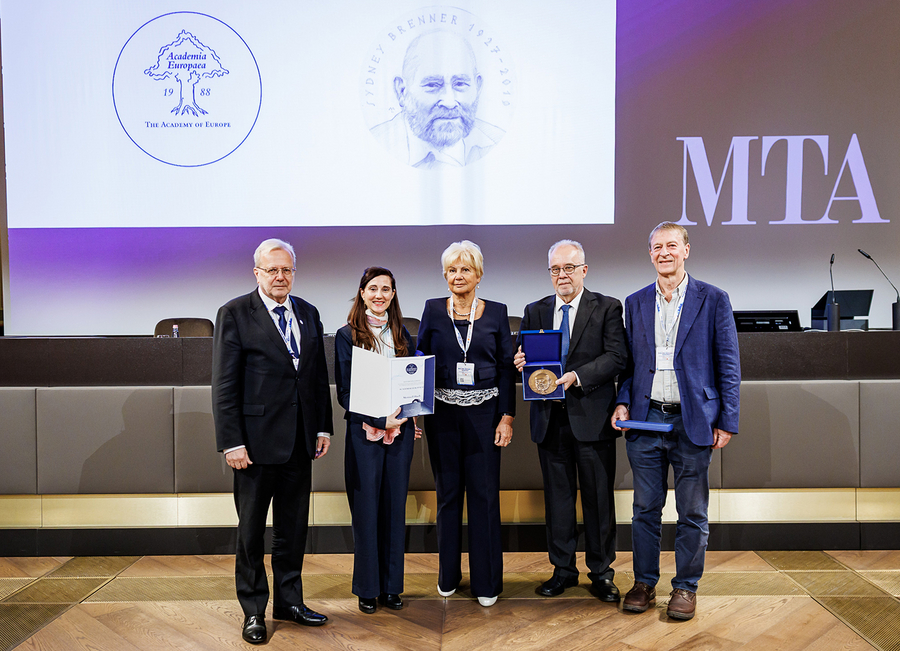
Meritxell Huch receives the Sydney Brenner Medal during the 37th Annual Conference of the Academia Europaea. From left to right: Balázs Gulyás MAE, President of HUN-REN Hungarian Research Network; Meritxell Huch; Éva Kondorosi MAE, Chair of Class C (Life Sciences) and board member of Academia Europaea; Donald B. Dingwell MAE, President of Academia Europaea, Philip Ingham MAE, Chair Professor in the Institute of Biomedical Sciences at Shanxi University, China. ©HUN-REN/DKP Visuals
During the 37th Annual Conference of the Academia Europaea “Building Bridges” from 12 to 16 October, 2026, in Budapest, Meritxell Huch, director at the Max Planck Institute of Molecular Cell Biology and Genetics (MPI-CBG), received the 2026 Sydney Brenner Medal in recognition of her transformative contributions with her organoid work to the field of cell biology.
Congratulations!
Meritxell Huch held the accompanying lecture “Organoid models and their applications in biomedical research” for her award on October 14th, 2026. Her pioneering research in stem cell and organoid biology has transformed the ability to culture, study, and apply tissues in vitro. As the first to establish long-term expandable organoid systems from the three human tissues of the stomach, liver, and pancreas, Meritxell Huch’s work has fundamentally reshaped human cell biology by overcoming a central dogma and the longstanding limitation of culturing primary human tissues in a dish. Her work enabled the expansion of patient-derived material as a scalable and physiologically relevant resource for human tissue ex-vivo. This breakthrough has transformed disease modeling, drug development, toxicology, regenerative medicine, and precision therapeutics across academia and industry, replacing key dependencies on animal models.
I am delighted and deeply honored to receive the Sydney Brenner Medal from the Academia Europaea in recognition of our pioneering work on organoid models. This award holds particular significance for me, given my long-standing admiration for Sydney Brenner, his groundbreaking discoveries, and his extraordinary contributions to science in particular, to the field of molecular biology. My lab and I pioneered the development of stomach, liver, and pancreas organoid cultures from adult mouse and human tissues. Our research program is not only focused on the development and improvement of organoid culture systems but also on using them to elucidate basic biological questions, from how tissues repair to how defects in the process result in disease. Our work on human tissues has the potential to dissect the cellular and molecular mechanisms underlying the development of human organs, human regeneration, and the pathogenic mechanisms of human diseases.
– Meritxell Huch
The Academia Europaea Sydney Brenner Medal was established in 2022 to commemorate biologist Sydney Brenner (1927-2019), one of the founding members of the Academia Europaea. He received the 2002 Nobel Prize in Physiology or Medicine together with H. Robert Horvitz and Sir John E. Sulston for their discoveries concerning genetic regulation of organ development and programmed cell death. The Sydney Brenner Medal is given to an individual scholar for outstanding contributions to the field of molecular and cellular biology and related disciplines.