
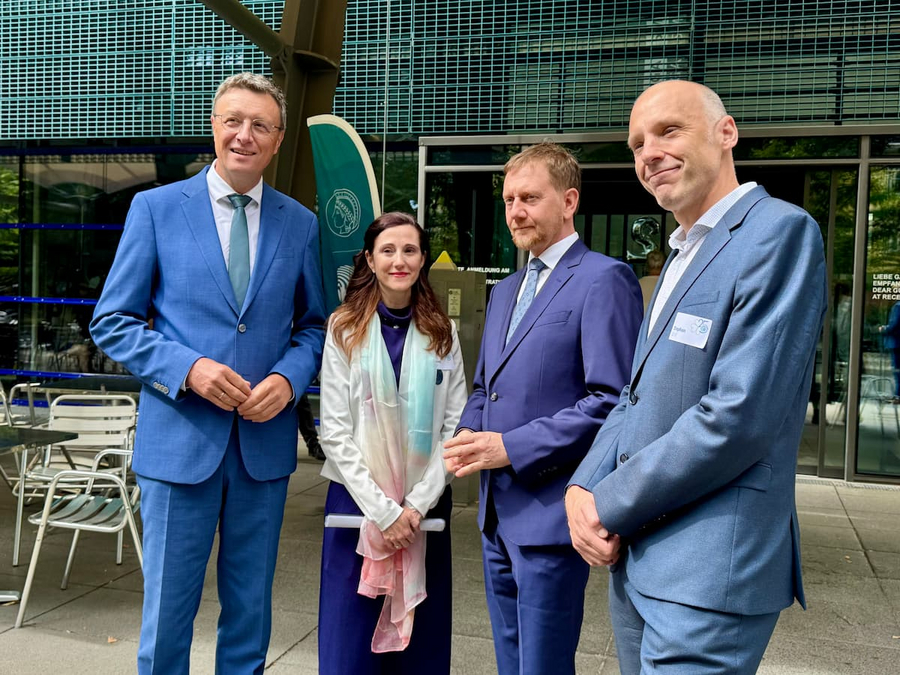
From left to right: Prof. Patrick Cramer, President of the Max Planck Society, Prof. Meritxell Huch, Director MPI-CBG, Michael Kretschmer, Minister President of Saxony, Prof. Stephan Grill, Director MPI-CBG © Katrin Boes / MPI-CBG
Foundation and location: The Max Planck Institute of Molecular Cell Biology and Genetics (MPI-CBG) was officially founded January 1, 1998. Dresden was chosen as the location for the new institute since the TUD Dresden University of Technology had a strong technical and engineering focus, and MPI-CBG could only benefit from it. The new research building was raised in record time – less than two years from groundbreaking to moving in on 22 January 2001.
Hub for interdisciplinary biological research: A key asset of MPI-CBG is a profound understanding of how to foster effective interdisciplinary research in the life sciences. Building on the institute’s success of combining physics with biology, the new portfolio includes mathematics and artificial intelligence.
2-day-celebration: The program for the anniversary festivities on August 24 and 25 includes an official ceremony with the Minister President of Saxony, Michael Kretschmer; the President of the Max Planck Society, Patrick Cramer; the State Secretary at the Saxon State Ministry for Science, Culture, and Tourism, Heike Graßmann; current and former MPI-CBG directors, and many more.
The MPI-CBG is celebrating its 25th anniversary since opening its building in Dresden on January 22, 2001. From the beginning, the institute has made a significant contribution to promoting scientific excellence and innovation and has played a key role in strengthening Dresden and Saxony’s position as an internationally recognized hub for research and discovery.
After the official foundation on January 1, 1998, MPI-CBG, the four founding directors Wieland Huttner, Anthony Hyman, Kai Simons, and Marino Zerial, initiated the appointment process for a biophysicist as the fifth director and appointed Jonathon Howard from the University of Washington in Seattle. Ivan Baines completed the team in November 1999 and built a central infrastructure for all research groups to have access to the latest technologies. Construction for the new research building began in 1999 on the former tram depot on Pfotenhauerstraße in Dresden. The building was designed by the Finnish architects Heikkinen-Komonen and Henn Architekten from Munich and cost 55 million euros.
"How do cells form tissues?" is the central scientific mission driving research at MPI-CBG. With the goal to understand how emergent properties at the tissue and organ levels arise from molecular and cellular activities. This endeavor requires integration across biological scales, combining molecular and cell biology with biophysical theory, mathematics, and systems-level approaches. Through this multi-scale approach, MPI-CBG seeks to establish links between fundamental cellular processes and the architecture of complex biological structures.
From the beginning, MPI-CBG was planned as a whole new infrastructure forming a biotechnology network, with open interactions between universities, institutes, and industry. In collaboration with the TUD Dresden University of Technology, the „International Max Planck Research School for Molecular Cell Biology and Bioengineering“ was established in April 2001, with spokesperson Wieland Huttner. MPI-CBG was also an integral part of founding DRESDEN-concept in 2010, which was a part of TUD’s application in the Excellence competition. The mission of DRESDEN-concept is to strengthen cooperation among its partner institutions. Over the years, there were six spin-off companies based on research results from MPI-CBG.
The two-day program for the 25th anniversary on August 24 and 25, 2026, features keynote lectures by Elly Tanaka, director at the Institute of Molecular Biotechnology of the Austrian Academy of Sciences at Vienna Biocenter, and Michael Bronstein, founding director of AITHYRA Research Institute for Biomedical Artificial Intelligence in Vienna. An official ceremony with Saxon Minister President Michael Kretschmer, Max Planck Society President Patrick Cramer, and State Secretary at the Saxon State Ministry for Science, Culture, and Tourism, Heike Graßmann, takes place on August 24. Both days feature about 130 talks from current and former employees of MPI-CBG.
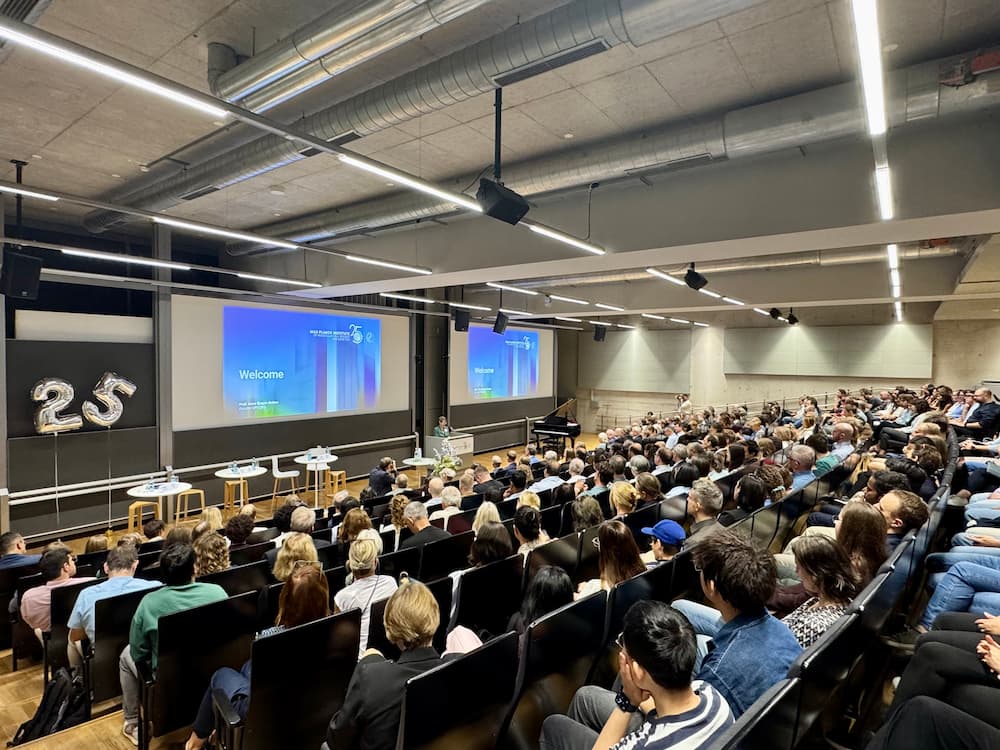
Prof. Stephan Grill, Managing Director at MPI-CBG
“Our fantastic institute turns 25 years old! The task at the beginning was clear: create a new world-class institute in Dresden with the vision to understand how cells form tissues. We tackled major research questions in molecular, cell, and developmental biology. We built a strong connection to physics and the Max Planck Institute for the Physics of Complex Systems. Together, these efforts turned us into a lighthouse, transforming research fields and leading the way in many scientific areas. In 2017, we added the Center for Systems Biology Dresden to our campus. In 2018, we made a major shift to organoids. And we keep moving. Living systems generate structure at all scales, and mathematics is essential for unravelling the problem of emergence in cells and tissues and across scales. Twenty-five years in, this institute is at its very best.”
Sebastian Gemkow, Saxon Science Minister
“The MPI-CBG’s 25-year history shows what can be achieved when curious researchers, ambitious ideas, and a strong scientific environment come together. Excellent science requires modern infrastructure, a long-term commitment, and stability. That is why we, as the Free State of Saxony, invest in our universities and research institutions and are committed to making Saxony an attractive location for the best minds from all over the world. Today we are also celebrating our shared commitment to scientific excellence, confident that its full potential will unfold in the future, particularly in basic research.”
Michael Kretschmer, Minister President of Saxony
“The Max Planck Institute of Molecular Cell Biology and Genetics is widely known far beyond the borders of Saxony for its excellent basic research. It is renowned for its outstanding work—thanks in part to close interdisciplinary collaboration with other research institutions and universities—and for valuable discoveries that pave the way for innovations in fields such as biomedicine and biotechnology. The institute is a vital part of the scientific ecosystem here in the Free State of Saxony. I would like to thank everyone who has contributed to this success story. Congratulations on your anniversary!”
Media Contact MPI-CBG
Katrin Boes
+49 351 210 2080
Email: kboes(at)mpi-cbg.de