
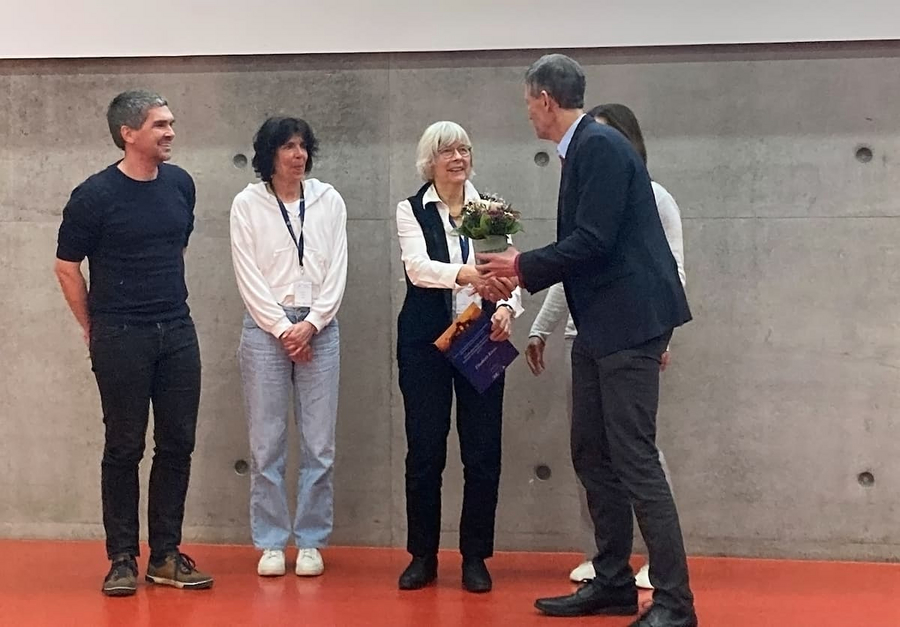
Elisabeth Knust receiving the Klaus Sander Award during the “Development & Regeneration” conference. © Jesse Veenvliet
The German Society of Developmental Biology (GfE) awarded this year's Klaus Sander Award to Elisabeth Knust, Director Emerita at the Max Planck Institute of Molecular Cell Biology and Genetics (MPI-CBG), for her lifetime achievements in developmental biology. The award was presented during the joint conference of the GfE, the Dutch Society for Developmental Biology (DSDB), and the Spanish Society for Developmental Biology (SEBD) on the topic of “Development & Regeneration” at the University of Potsdam. Elisabeth Knust held the award lecture with the title “From phenotypes to function—or—the privilege to do curiosity-driven research” on March 12th, 2026.
In her groundbreaking scientific research, she has contributed to the understanding of the molecular and cellular mechanisms underlying the development of epithelial cell polarity in the fruit fly Drosophila. Genes characterized by her group are highly conserved and control fundamental mechanisms, which are also relevant to humans and of great biomedical importance for the understanding of tumors and other pathologies.
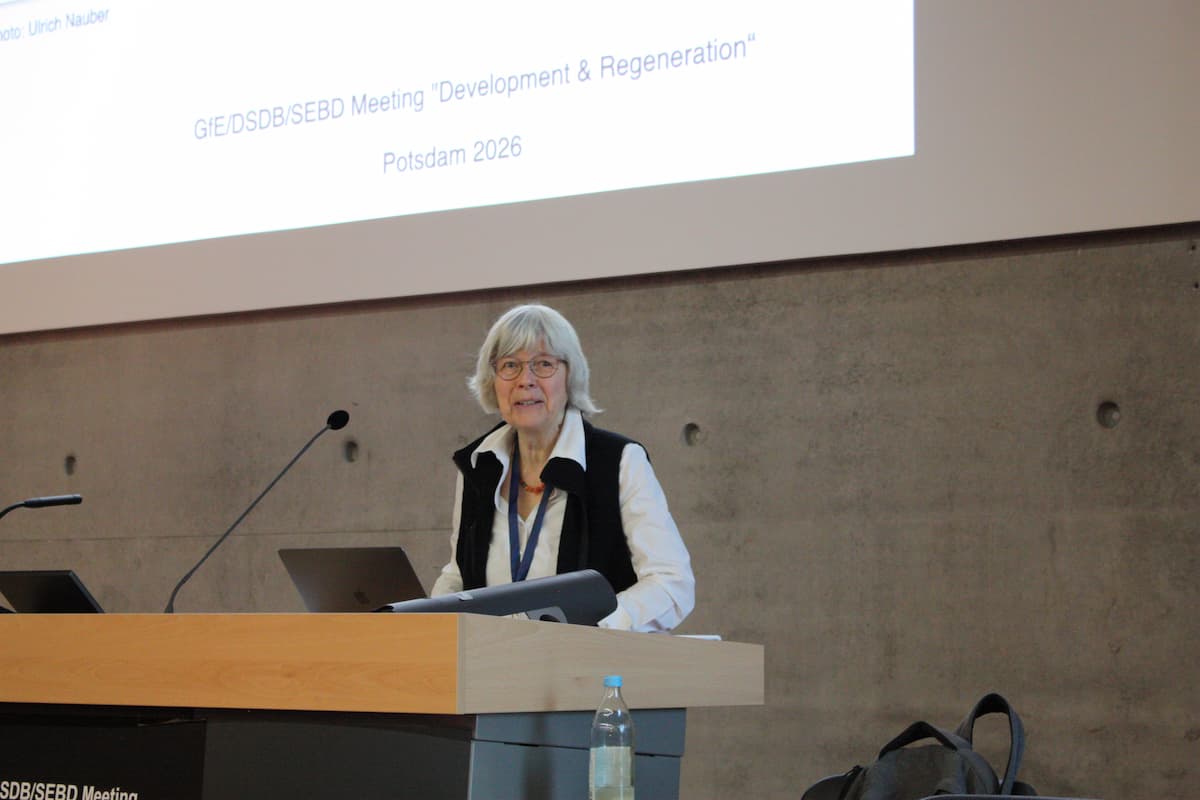
Elisabeth Knust held the award lecture with the title “From phenotypes to function—or—the privilege to do curiosity-driven research” on March 12th, 2026. © Mahsa Hosseinalipour
Some of these genes control important signaling pathways, for example, the conserved Notch pathway. They can prevent retinal degeneration both in flies and in humans, where their loss can lead to blindness. I am very grateful for this recognition, which also highlights the importance of curiosity-driven research.
-Elizabeth Kunst
Since 2017, the Society for Developmental Biology (GfE) has been awarding the Klaus Sander (1929-2015) Award to honor the Freiburg developmental biologist, who became known primarily for his studies on the processes of embryonic pattern formation. He coined the term ”phylotypic stage," a developmental stage typical of an animal phylum. Klaus Sander also revived the legacy of his Freiburg predecessors, August Weismann, Hans Spemann, and Hilde Mangold, and developed it further. In addition, the GfE, together with the SEDB, also awarded the José Campos-Ortega Prize to recognize outstanding research and activity in the field of developmental neurobiology and the Hilde Mangold Prize, aimed at young scientists.
Elisabeth Knust, born in 1951, completed her PhD in biology at the University of Düsseldorf in 1979 and worked as a postdoctoral fellow at the Institute of Clinical Virology at the University of Erlangen-Nürnberg (1980–1983). She was an assistant professor at the Institute of Developmental Biology at the University of Cologne from 1983 to 1988 and a Heisenberg Fellow at the University of Cologne and the University of Boulder, Colorado (1988–1990). She became a full professor for developmental biology at the University of Cologne in 1990, then moved on to the Heinrich Heine University in Düsseldorf as a full professor and head of the Institute of Genetics in 1996. She became one of the Directors at the MPI-CBG in 2007. Elisabeth Knust received the Gottfried Wilhelm Leibniz Prize in 1997. She became Director Emerita in 2019.