
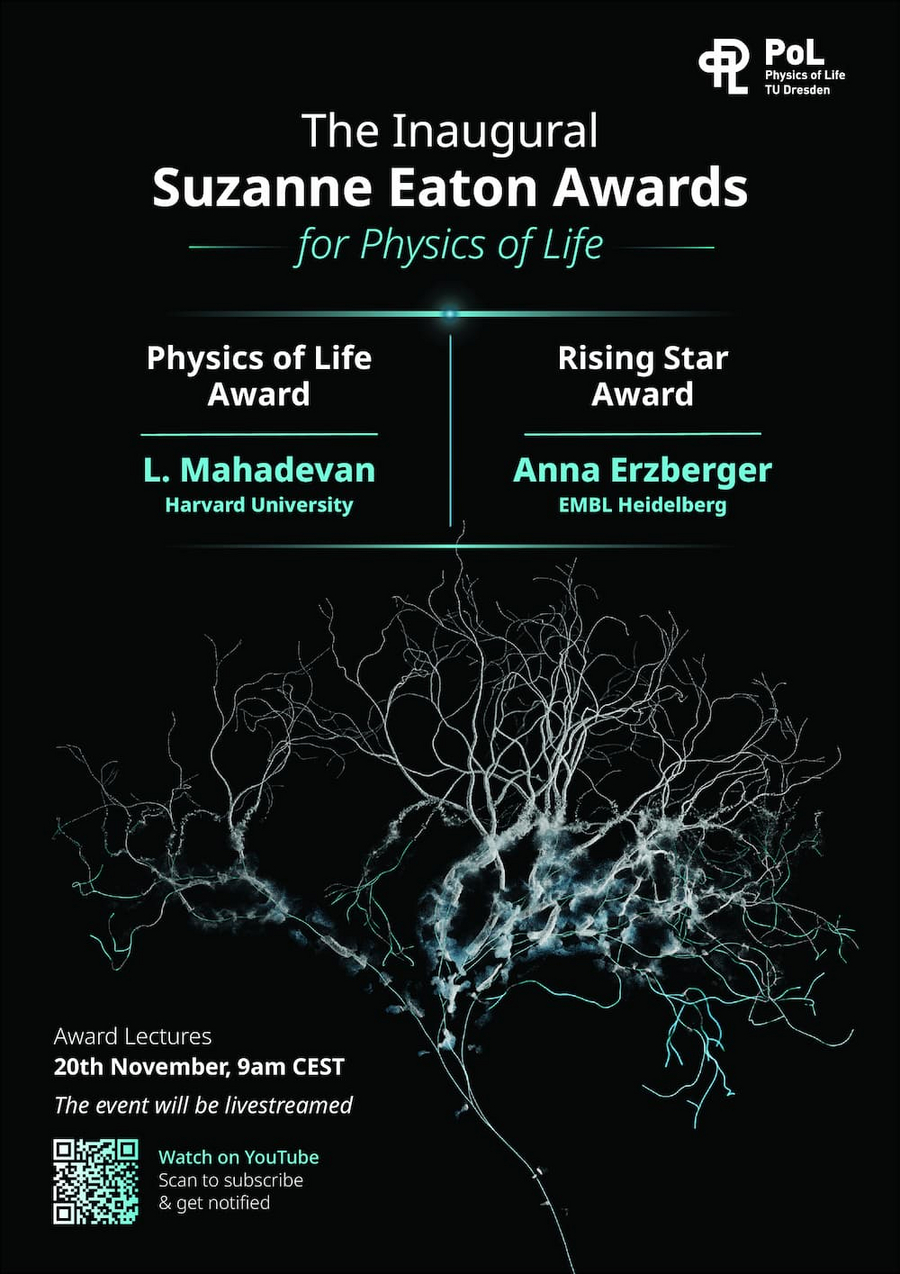
Announcement poster for the Suzanne Eaton Awards for Physics of Life © PoL
The Cluster of Excellence Physics of Life (PoL) at TUD Dresden University of Technology has established new international awards in honour of Suzanne Eaton (1961–2019). Suzanne was a research group leader at the Max Planck Institute of Molecular Cell Biology and Genetics (MPI-CBG) in Dresden since 2001. She was essential for the establishment of the Cluster of Excellence Physics of Life (PoL) at TU Dresden, and served as one its founding spokespersons.
Eaton made foundational contributions to understanding how tissues acquire their shapes and sizes, through her work on Drosophila wing morphogenesis and her pioneering studies on the long-range dispersal of morphogens. Beyond her own discoveries, she played a key role connecting biological and physical approaches to study living systems, and was a central figure in establishing Physics of Life as a field. This award reflects her enduring legacy and the spirit of interdisciplinary thinking that she brought to the study of life itself.
The Suzanne Eaton Awards for Physics of Life recognize outstanding scientific contributions to the physics of living systems, encompassing theoretical, experimental, and computational work at the interface of physics and biology. The Awards are presented in two tiers: the Suzanne Eaton Physics of Life Award and the Suzanne Eaton Rising Star Award.
The Selection Committee has chosen L. Mahadevan, Professor at Harvard University, as the recipient of the inaugural 2026 Suzanne Eaton Physics of Life Award. The inaugural 2026 Rising Star Award will go to Anna Erzberger, group leader at the European Molecular Biology Laboratory (EMBL).
To honour both recipients, an award ceremony will be held at the Annual Meeting of the Physics of Life Excellence Cluster in Dresden (Germany). The event will take place on November 20, 2026 from 9 a.m. to 11.30 a.m. and livestreamed for international viewers on the Physics of Life YouTube channel.
Suzanne Eaton Physics of Life Award recipient: L. Mahadevan (Harvard University)
L. Mahadevan is the Lola England de Valpine Professor of Applied Mathematics, Organismic and Evolutionary Biology, and Physics at Harvard University. His work has helped define physics of life by showing how a small set of theoretical principles closely linked with experiments determine the shapes and motions of multicellular tissues, organs, organisms and their collectives. From gastrulation to gut looping and brain folding, from stem to leaf and flower morphology, his contributions to the field have shown the importance of growth and activity driven instabilities for the emergence of complex functional shapes. Separately, he has illustrated how plants exploit instabilities to turn slow biological processes into fast, robust motion, how rapid muscle contraction rates are ultimately limited by slow water movements, and how the brain, body and environment work together to coordinate the dynamics of locomotion in such instances as crawling worms, slithering snakes and walking and swimming fish.
Further work by his group on active and collective systems — from cytoskeletal assemblies to cell sheets, and social insects including termite swarms, ant colonies and bee clusters — has framed living collectives as adaptive, sentient matter that uses distributed physical intelligence to solve physiological problems on scales much larger than individuals. The breadth of topics covered by his research is a testament to his remarkable creativity, which has helped exchange ideas between physics, biology, engineering and mathematics, for the benefit of each discipline. He is a MacArthur Fellow, a Fellow of the Royal Society of London, and a member of the American Academy of Arts and Sciences and the U.S. National Academy of Sciences
“It is a tremendous honor to be the inaugural recipient of the Suzanne Eaton Physics of Life prize. Suzanne Eaton’s infectious enthusiasm for science without boundaries has long been a driver for the field, and I was fortunate to have been part of the circle that she influenced and led. Working at the interface of physics and biology with a wonderful group of students, postdocs and colleagues has been a privilege that I am grateful for, and the award is a recognition of our collective efforts.”
Rising Star Award: Anna Erzberger, EMBL Heidelberg
Anna Erzberger is a group leader at EMBL Heidelberg, where her research investigates the theoretical principles of self-organisation in complex systems, using cellular and multicellular systems as paradigms. Her contributions span the mechanics of early mammalian development, the emergence of supracellular fluidity in patterning processes, and the role of active surfaces and shape fluctuations in cellular signal processing. In 2025, she was awarded an ERC Starting Grant and selected as an EMBO Young Investigator.
“Having our work recognized in association with Suzanne Eaton’s legacy is an incredible honor. To me, her achievements and the way of conducting science revealed under what conditions an enormous domain of problems can become scientifically accessible. A big part of that was an uncompromisingly collaborative approach, that continues to serve as the highest standard of effective interdisciplinarity in our community.”