
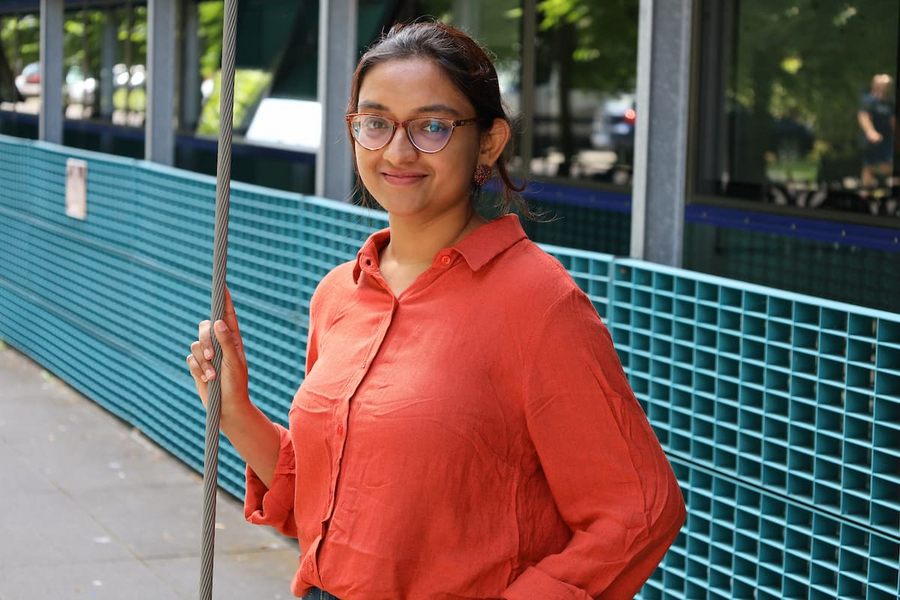
Dr. Smitaroopa (Smita) Kahali © Kostas Margitudis / MPI-CBG
Postdoctoral researcher Smitaroopa (Smita) Kahali, in the research group of Anthony Hyman at the Max Planck Institute of Molecular Cell Biology and Genetics (MPI-CBG), received a Humboldt Research Fellowship from the Alexander von Humboldt Foundation.
Her work will focus on understanding the microenvironment within biomolecular condensates, liquid-like droplets within a cell that form without membranes and are used by cells to organize many of their internal processes. Smita aims to investigate how microenvironmental conditions vary within condensates, how they differ across different types, how they are established and maintained, and how they influence protein structure, activity, and ultimately condensate function. To address these questions, she will primarily use fluorescent sensors, which are small-molecule sensors to track specific molecules, building on her expertise in sensor development acquired during her PhD. This technique will be complemented by other orthogonal techniques - measurements that use different physical principles to measure the same property of the same sample in order to reduce bias and uncertainty.
Smita comes from Kolkata (India), and she recently obtained her PhD in chemistry at the Tata Institute of Fundamental Research, Mumbai, India. She joined MPI-CBG in March 2026, where she will continue her research for the next two years.
She says,
With a chemistry background, I didn’t have the opportunity so far to explore biological perspectives, but I think it’s important to understand the complexity beyond the chemistry applications, so I decided to shift to the biology field. In the Hyman lab, I am getting this new view, and I am learning a lot. Also, I always lived in big cities, so I like Dresden because it is small, pretty, and everything is nearby.
Congratulations, Smita!
The Alexander von Humboldt Foundation supports researchers from all over the world through the Humboldt Research Fellowship. It enables postdoctoral researchers to conduct long-term research in Germany for 6 to 24 months.