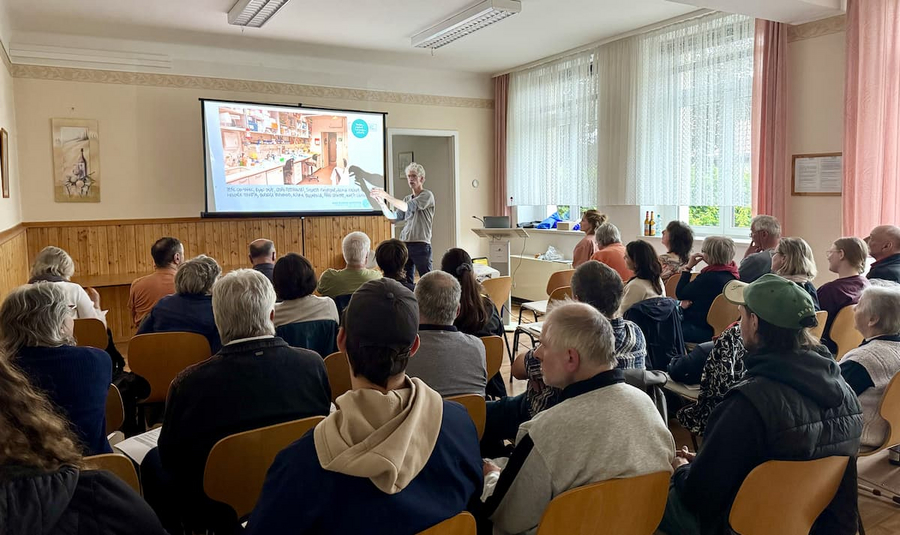
Guests at the Heimspiel Wissenschaft in Kaltwasser. © Katrin Boes / MPI-CBG
How do cells in an organism organize into tissues? On June 12, 2026, Katrin Boes, a science communicator at the Max Planck Institute for Molecular Cell Biology and Genetics (MPI-CBG), Ina Hollerer, a molecular biologist, and Eric Geertsma, a biochemist—both researchers at MPI-CBG—visited the village of Kaltwasser in the municipality of Neißeaue. The event took place as part of the “Heimspiel Wissenschaft” series—the first such event organized by MPI-CBG. “Heimspiel Wissenschaft” brings researchers and staff in the field of research who come from more rural areas back to their hometowns. They talk about what their research focuses on, how they do it, and why—and how it relates to our lives. This makes science and research accessible in the local pub, the community center, the sports clubhouse, or the village square.
Three short, illustrative presentations focused on research at MPI-CBG. In her presentation, Katrin Boes—who grew up in Kaltwasser—explained, among other things, what basic research is and why it is so important. Eric Geertsma's presentation featured a video he created himself to demonstrate what proteins are and how their function contributes to human health and disease—for example, in hearing or how defective proteins can lead to cerebral edema. Ina Hollerer asked in her presentation whether science contradicts itself and used the atomic model to show that science can only ever create models based on the knowledge available at the time and that these models continue to evolve over time.
After the presentations, the guests asked many questions, and there was time for in-depth discussions. Using a microscope, the guests were able to observe the nematode C. elegans. The guests showed great interest not only in the scientific content but also in learning more about how scientists think and work.
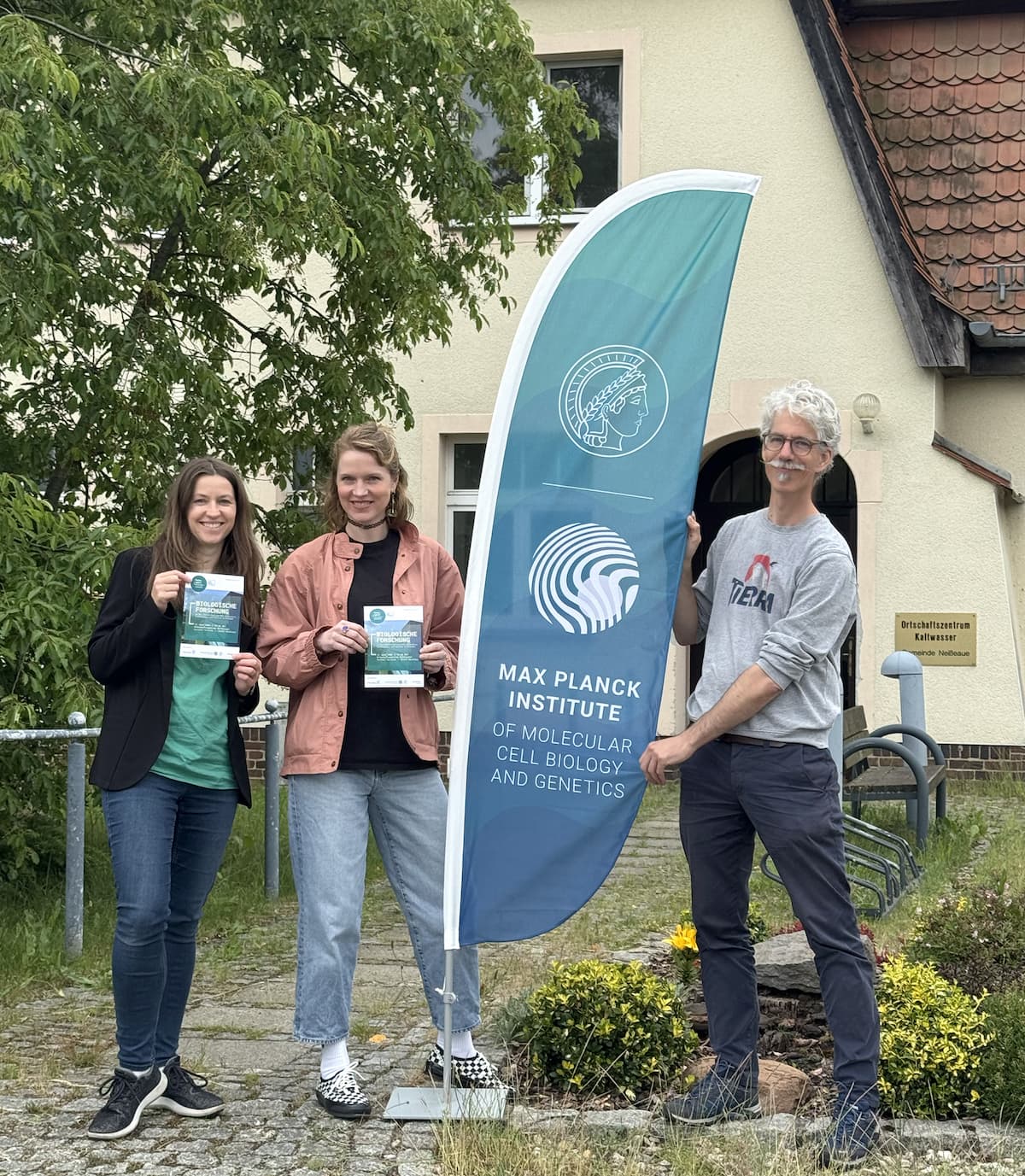
Katrin Boes, Ina Hollerer, Eric Geerstma (from left to right). © Evelin Bergmann
“Heimspiel Wissenschaft” was funded by the BMBF as part of the Science Years initiative between 2022 and the end of 2024 as a joint project of the German Rectors’ Conference (HRK), the science communication agency con gressa GmbH, and the #WisskommLab at Heidelberg University. The project is continuing with con gressa as the organizing partner in consultation with the HRK.
“Heimspiel Wissenschaft – Max Planck Edition” is exciting for the Max Planck Society (MPG) as a non-university research institution. The MPG is primarily dedicated to basic research, which can be challenging to communicate to a broad public. The “Heimspiel” format offers an exciting approach that creates opportunities for direct exchange and brings science closer to audiences in rural areas. After all, this format is not primarily about traditional academic lectures. Rather, the focus is on personal interaction: Who are the people behind the research? What is their daily life like? What brought them to the MPG?