
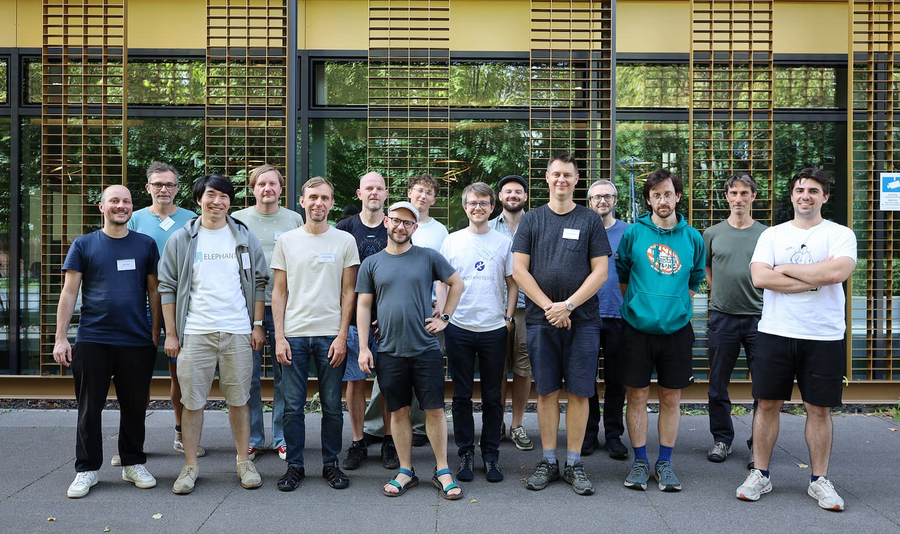
Participants of the Hackathon. © Katrin Boes / MPI-CBG
Bioimaging experts met at the Max-Planck-Institute of Molecular Cell Biology and Genetics (MPI-CBG) and the Center for Systems Biology Dresden (CSBD) from September 7 to 11, 2026, for a week of collaborative development. Fifteen international research software engineers, maintainers, and data stewards joined the OME-Zarr Hackathon.
The bioimaging community is increasingly converging on OME-Zarr as a standard for storing, sharing, and visualizing imaging data. OME-Zarr is an open, cloud-ready format that stores large microscopy images as chunked, multi-resolution data with respective metadata so that tools can read parts of a dataset without loading it all. While some tools already provide strong support, others are still in the early stages of adoption.
Stefan Hahmann, one of the hackathon organizers and software engineer in the group of Pavel Tomancak at MPI-CBG, says, “Microscopy data should not be locked into the tool it was created with. OME-Zarr aims to give the community a common format, and this week in Dresden is about making sure the implementations are closing the gaps to the written specifications. It is a fantastic opportunity: the developer community around Fiji/Java meets the Python side and the authors of the OME-Zarr specification, all in one room for a full week of moving the tools forward.”
Vladimír Ulman, co-organizer of the hackathon and researcher at CEITEC, Brno and IT4Innovations National Supercomputing Center, Ostrava, says, “A hackathon like this is hard to replace with online meetings, and we are very thankful to MPI-CBG and CSBD for hosting us in Dresden. The work we are doing this week on OME-Zarr and its accompanying tools enables fast and energy-efficient image processing—a major focus in my supercomputing work. Meeting here in Dresden makes this even better, as it significantly reduces our collective travel carbon footprint.”
The hackathon is supported by the Chan Zuckerberg Initiative, by CEITEC - Central European Institute of Technology in Brno, Czech Republic, and by German BioImaging – Gesellschaft für Mikroskopie und Bildanalyse e.V. (GerBI-GMB e.V.).