
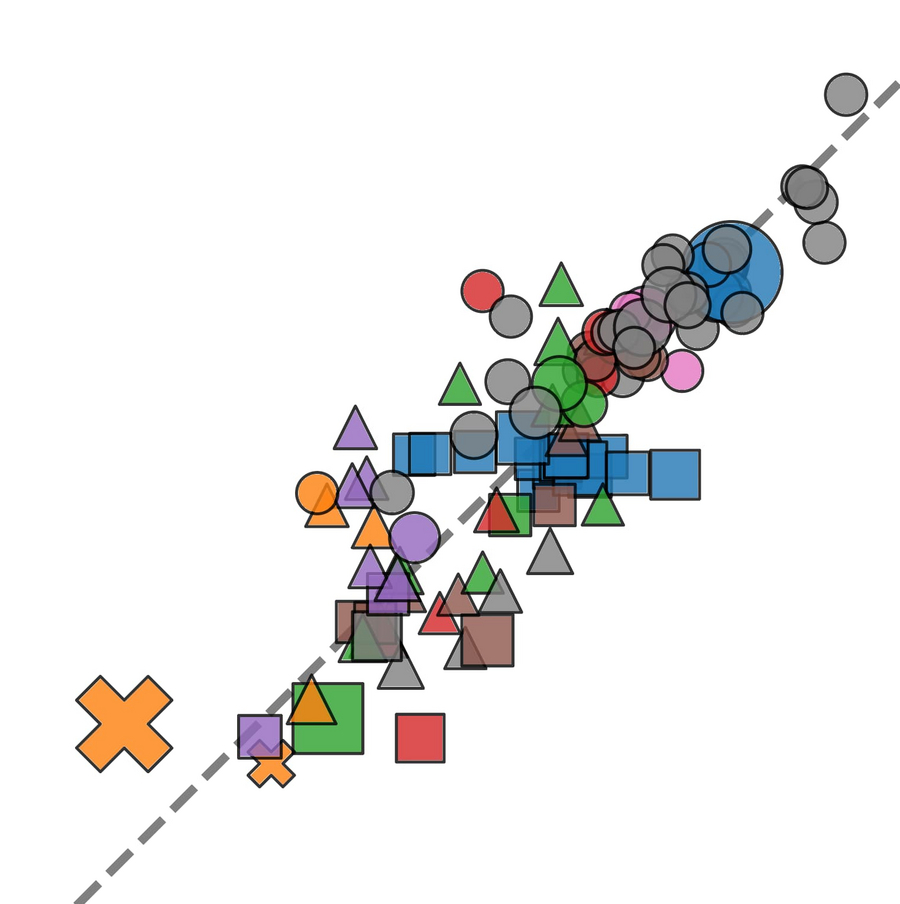
Energy waste (y-axis) plotted against biomass yield (x-axis) for various microbial organisms and metabolic types (colors and symbols). The dashed line represents the linear correlation between energy waste and biomass yield, indicating that all microbial organisms expend the same amount of energy to grow a unit mass of themselves. © Cosetto et al., Nat Commun 16, 8543 (2025) / MPI-CBG
Life can be found almost everywhere on earth. At the core of life's ability to adapt to different environments and thrive lies cellular metabolism – a complex network of chemical reactions that converts nutrients into mass and energy.
Metabolism constantly maintains a flux of energy and matter that is vital to cells, so scientists speculated that thermodynamics imposes fundamental constraints on life's ability to sustain itself. Thermodynamics states that, first, energy can only change form, not be created or destroyed. Second, whenever energy is utilized, part of it must be wasted—degraded to a form that cannot be used anymore. This means that organisms must be careful: they need to expend energy to grow, but if they waste too much, they may be left without it. However, how organisms utilize energy to grow and how growth is constrained by thermodynamics remain largely unknown.
Researchers in the group of Jonathan Rodenfels at the Max Planck Institute of Molecular Cell Biology and Genetics (MPI-CBG) in Dresden, Germany, and in the group of Pablo Sartori at the Gulbenkian Institute for Molecular Medicine in Oeiras, Portugal, sought to understand how the laws of thermodynamics influence cellular growth. The team realized that a black-box type of approach might be the key to solving this problem. This approach—common in bioengineering—allows researchers to work with minimal information. It cannot describe how energy is processed inside the cell, but it enables us to calculate how much energy is wasted.
Tommaso Cossetto, the lead author of the study and a former postdoctoral researcher in the Rodenfels and Sartori groups, explains, “We applied this method to a large set of data from many different published studies and used it to quantify how much energy is dissipated or wasted by microbes as they grow. We then used nonequilibrium thermodynamics—a theory from physics—to analyze this data.”
Their study, published in Nature Communications, identifies two thermodynamic rules governing the growth and energy utilization of single-celled organisms, including archaea, bacteria, and yeast. Different types of microorganisms waste about the same amount of energy to grow a unit of biomass. This is the case whether they use oxygen, inorganic molecules, or fermentation as a metabolic strategy to grow. As a second rule, however, the team found that the use of oxygen requires more energy to produce biomass. This makes aerobic respiration, the process by which a cell uses oxygen to grow, a more efficient way for cells to grow than anaerobic respiration or fermentation, as the energy wasted is a smaller proportion of the energy required.
“Our two empirical rules constitute a long-sought-after connection between metabolism and thermodynamics,” say Jonathan Rodenfels and Pablo Sartori, who oversaw the study. “We found that there are fundamental limits to how cells can grow and function. Our findings are based on observations and data, but we don't yet understand the molecular and mechanistic reasons behind these limits. Further research will help us understand how cells work and how they can be improved or optimized.”
Tommaso Cossetto, Jonathan Rodenfels & Pablo Sartori: Thermodynamic dissipation constrains metabolic versatility of unicellular growth. Nat Commun 16, 8543 (2025). https://doi.org/10.1038/s41467-025-62975-5