
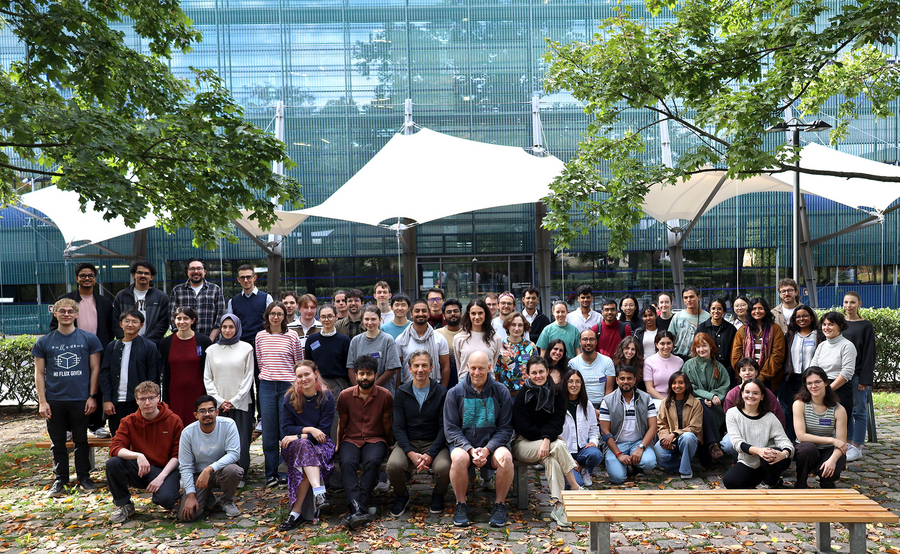
Group picture of the participants. © Katrin Boes / MPI-CBG
From October 5th to 9th, the Max Planck Institute of Molecular Cell Biology and Genetics (MPI-CBG) and Cluster of Excellence Physics of Life (PoL) at the TU Dresden welcomed researchers to the one-week course for Physical Biology of the Cell. The event took place at MPI-CBG and brought together about 60 life scientists interested in the quantitative analysis of living matter from across the Dresden scientific community. It’s the third time the course took place at MPI-CBG, previously being held in 2022 and 2024. At the center of the course was the question “How can physics and mathematics help us understand living systems?”
The course was held by two leading biophysicists: Rob Phillips, the Fred and Nancy Morris Professor of Biophysics, Biology, and Physics at the California Institute of Technology, and Jané Kondev, the William R. Kenan Jr. Professor of Physics at Brandeis University. To explore how simple physical and mathematical ideas can provide powerful insights into biological systems, the course combined lectures with problem-solving and hands-on computational tutorials.
Phillips and Kondev, together with teaching assistant Sara Mahdavi, focused not on teaching a particular set of technical skills but instead on developing a way of thinking: how physical and mathematical reasoning can be used to ask and answer questions in the life sciences. The participants explored, for example, diffusion as biology’s null hypothesis for dynamics or active matter and phase separation to understand how complex organization emerges in biological systems.
Known for his innovative and philosophical teaching style, Rob Phillips broke down complex topics into manageable pieces that left the audience with key takeaways. Phillips has earned an international reputation as a teacher and has traveled extensively to conduct the course at various institutes. For his unconventional and excellent teaching skills, Phillips received the 2021 Richard P. Feynman Prize for Excellence in Teaching, Caltech's highest teaching prize.