
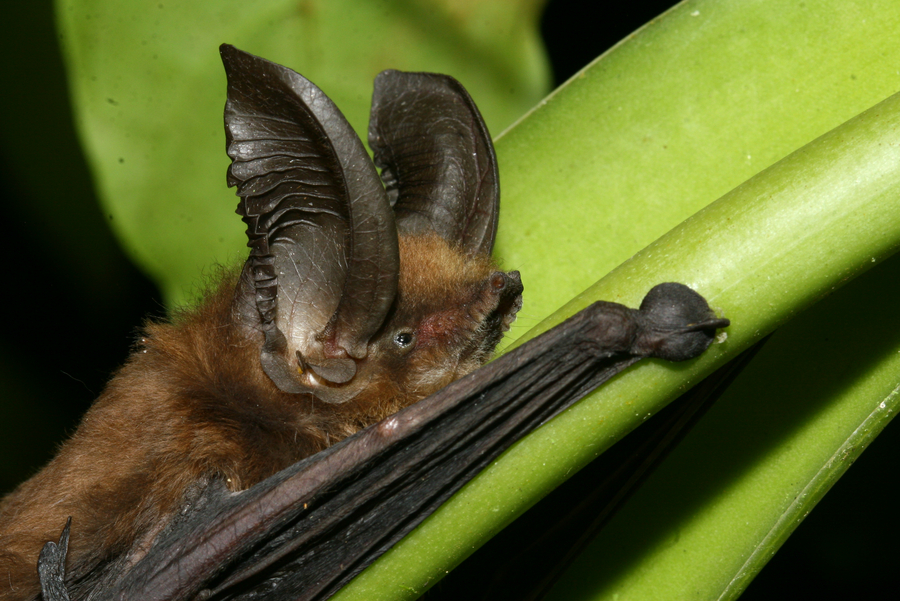
The genome of the bat Old World sucker-footed bat (Myzopoda aurita) from Madagascar and 29 other bat species were sequenced and assembled by the MPI-CBG Sequencing Facility and the DRESDEN-concept Genome Center. ©Manual Ruedi, Muséum d'histoire naturelle de la Ville de Genève
An international team of 137 researchers from 64 countries, working together as part of the Bat1K consortium, published a landmark study in the journal Nature. This largest combined bat genome and fossil study ever undertaken finds that bats most likely originated in Europe around 65 million years ago, before spreading across the world. These results overturned previous hypotheses proposing Asian, African, or North American origins of bats. The work also reveals that echolocation, like flight, evolved near the dawn of bat evolution and lays the groundwork for research into the genetic basis of bats' exceptional longevity and disease resistance, with potential relevance to human health.
The team assembled the largest collection of high-quality bat genomes to date, covering 103 species and representing every one of the currently recognized 21 bat families. “We combined state-of-the-art DNA sequencing and computational methods to generate and compare these genomes and identify the genes they contain,” says Michael Hiller, senior author at the Senckenberg Research Institute in Frankfurt and Alumni at the Max Planck Institute of Molecular Cell Biology and Genetics (MPI-CBG). The researchers combined them with 44 fossil bats from across the globe to reconstruct the evolutionary history of the world's only flying mammals.
In total 103 bat species were analyzed, including 42 new chromosome-level genome assemblies representing 41 distinct species. The Sequencing Facility at MPI-CBG and the DRESDEN-concept Genome Center sequenced and assembled 30 of the 42 new genomes. MPI-CBG Alumni Michael Hiller and Eugene Myers were involved in the study.
It was amazing to get in touch with field biologists, sample curators and bat experts and to learn about the specific habitats, features and power of bats. As technologists, it was our job to implement state-of-the-art sequencing technologies to generate almost complete genome assemblies that allow this fantastic analysis.
- Sylke Winkler, head of the Sequencing Facility at MPI-CBG
Building this dataset required samples collected over decades from bats across the world, including representatives of some of the rarest and most unusual bat families, found in the most remote locations.
The fossil evidence also provides important clues about another long-standing mystery: when bats first evolved echolocation. The placement of the fossil bat Vielasia within the oldest branch of the bat family tree indicates that echolocation predates the diversification of modern bats. The finding suggests that two of the defining characteristics of bat biology, echolocation and powered flight, were established near the origin of the group itself, helping explain the extraordinary evolutionary success of bats over the subsequent 65 million years.
This study provides answers to many long-standing questions. The team analyzed these genomes and fossils using novel methods and revised the bat evolutionary tree, resolving several long-running debates about how the major bat groups are related.
“Bats constantly surprise us. They are one of evolution’s greatest experiments. This extraordinary genomic resource, the culmination of years of international cooperation of Bat1K, is finally allowing us to understand how their remarkable biology evolved,” says Sonja Vernes, University of St Andrews, Bat1K co-founding director and senior author.
About Bat1K
The Bat1K consortium is an international initiative working to generate and analyse reference-quality genome assemblies for all living bat species. This study represents Phase 1 of the project. See more at www.bat1k.com
Press Release of the University of St Andrews
Morales, A.E., Liang, Y., Thomas, W.R. et al. Reference genomes and fossils revise bat family phylogeny and biogeography. Nature (2026), doi: 10.1038/s41586-026-11007-3