
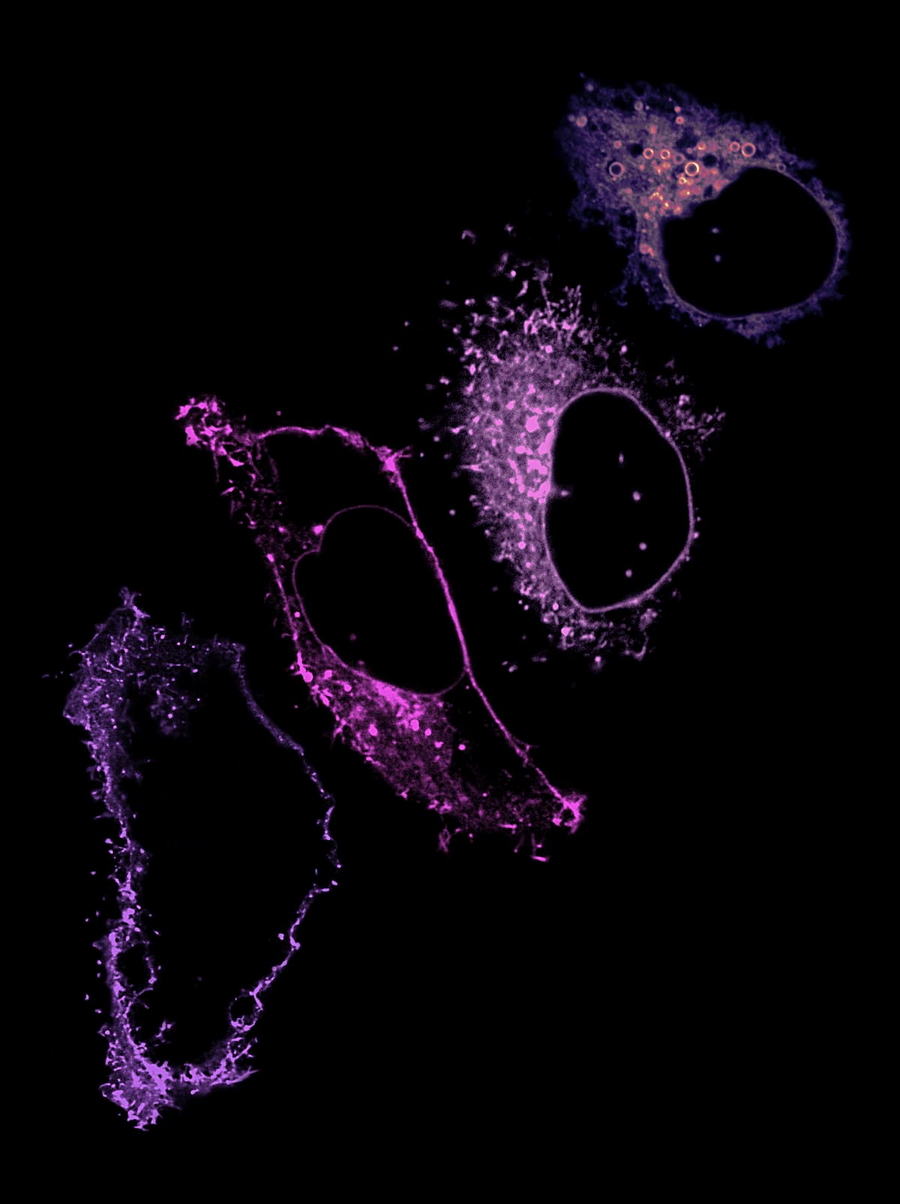
Artistic representation of lipid localization over time in mammalian cells. © Böhlig et al. / Angew. Chem. Int. Ed. 2025/ MPI-CBG
Ether lipids play a crucial role in various biological processes, such as cell membrane structure and function, metabolism, immune responses, and many more. They are special phospholipids that are only different by a few atoms, and they make up around 10 to 20% of all phospholipids. A lack of ether lipids causes severe diseases such as rhizomelic chondrodysplasia punctata (RCDP) with severe neurodevelopmental deficits and physical disabilities. Despite their clinical significance, the functional roles of ether lipids are unknown, since the tools to study ether lipid biology are lacking.
Scientists at the Max Planck Institute of Molecular Cell Biology and Genetics (MPI-CBG), the Helmholtz-Zentrum Dresden-Rossendorf (HZDR), and the École Polytechnique Fédérale de Lausanne (EPFL) have developed new tools to get mechanistic insights into ether lipid biology.
The research team used chemically modified ether lipids with two distinct reactive groups. Those so called bifunctional lipids allow to visualize ether lipid localization and study their interaction with proteins for the first time.
A combination of fluorescence imaging, machine learning-assisted image analysis, and mathematical modelling revealed unique transport mechanisms of individual ether lipids.
“Using our new tools, we discovered that non-vesicular transport is the main mechanism for ether lipid transport,” explains Kristin Böhlig, who led the study. She continues, “However, some ether lipid types are transported faster than others, suggesting the presence of specific, so far undiscovered lipid transport proteins that can distinguish between ether lipid types.”
These results imply that the cellular lipid handling machinery is capable of identifying even small structural differences in ether lipids, adding to the evidence supporting the biological significance of lipid diversity.
“Our bifunctional ether lipid probes provide a flexible toolkit for studying ether lipid biology in detail. This will have significant benefits for understanding the functions of ether lipids in fundamental cell biology and their role in human diseases,” says André Nadler, who oversaw the study. “Studying ether lipids in mechanistic detail may in the future help to develop new treatments for diseases that are caused by imbalances in lipid metabolism.”
Kristin Böhlig, Juan Manuel Iglesias-Artola, Antonino Asaro, H. Mathilda Lennartz, Anna C. Link, Björn Drobot, André Nadler: Bifunctional Probes Reveal the Rules of Intracellular Ether Lipid Transport. Angew. Chem. Int.
Ed. 2025, e202513360, doi.org/10.1002/anie.202513360