
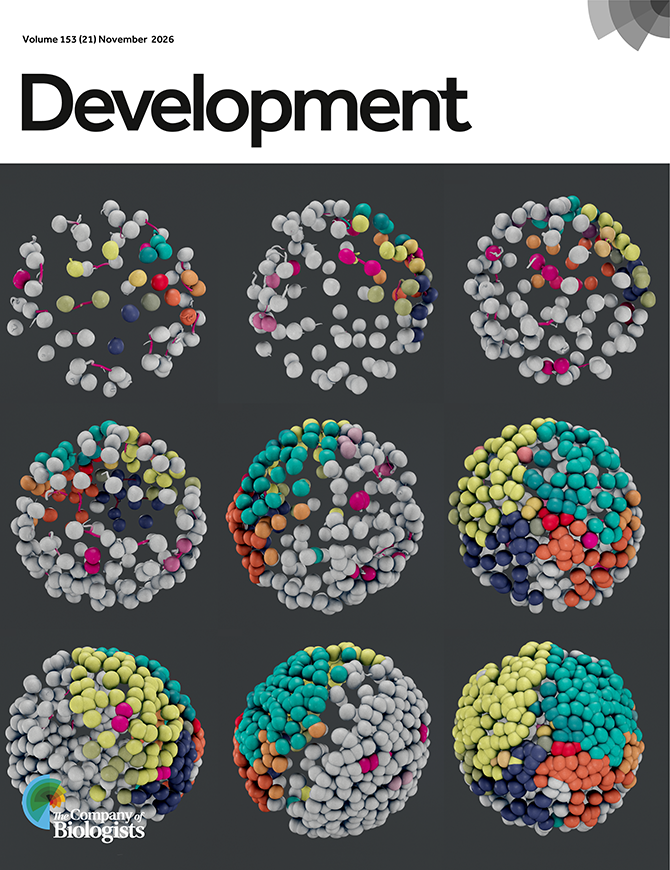
Embryonic development of the annelid Platynereis dumerilii, tracked over 15 hours and visualized in 3D using the Mastodon-Blender bridge. Brain progenitor cell lineages are colour-coded from the 38-cell early cleavage stage to the 754-cell early larval stage. © Mette Sandberg Thorsager / MPI-CBG / Development (2026)
To understand the development of living organisms, scientists need to follow the divisions, movements, and fates of individual cells. Modern microscopes can capture images of entire embryos at the level of single cells. However, tracing the “family trees” of cells (cell lineages) from these huge image datasets is still a challenge.
A research team at the Max Planck Institute of Molecular Cell Biology and Genetics (MPI-CBG) in Germany and the Institut Pasteur in France have now developed a flexible software platform for tracking cells in large images, called Mastodon. It supports manual, semi-automated, and fully automated tracking. Mastodon uses a specially designed data structure that stays fast and responsive even with millions of annotations, so it can handle huge datasets.
“Mastodon runs as a plugin for Fiji, a widely used image analysis program. It lets users view, edit, and analyze complex lineage trees while keeping them directly linked to the original images. It also works with Blender, a powerful free 3D rendering program, which makes it easier to understand lineages in complex 3D shapes,” explain the lead authors Johannes Girstmair and Tobias Pietzsch, and both former postdoctoral researchers in the group of Pavel Tomancak at MPI-CBG.
Jean-Yves Tinevez, head of the image analysis hub at Institut Pasteur and one of the authors, who oversaw the study, says, “Mastodon is the first and, to the best of our knowledge, the only tracking tool that lets you track millions and millions of cells and manually curate the tracking results while remaining responsive and interactive enough to allow seamless exploration of both the image and the tracking data.”
Pavel Tomancak, research group leader at MPI-CBG and co-corresponding author, adds, “Mastodon is future-proof. We don't have big enough real biological datasets to break its functionality. That is why we implemented, inside Mastodon, a capacity to simulate ludicrously large embryo-like datasets and a software framework to measure the performance of Mastodon when facing such large data.”
The authors think that Mastodon can also be used beyond developmental biology in areas like cancer evolution, regenerative medicine, and organoid research, growing as a community-driven ecosystem where users contribute their own modules and analysis routines.
Johannes Girstmair, Tobias Pietzsch, Vladimir Ulman, Stefan Hahmann, Matthias Arzt, Mette Handberg-Thorsager, Samuel Pantze, Ko Sugawara, Robert Haase, Shuichi Onami, Jean-Yves Tinevez, Pavel Tomancak: Mastodon: the command center for large-scale lineage-tracing microscopy datasets. Development (2026) 153 (21): dev205569. https://doi.org/10.1242/dev.205569