
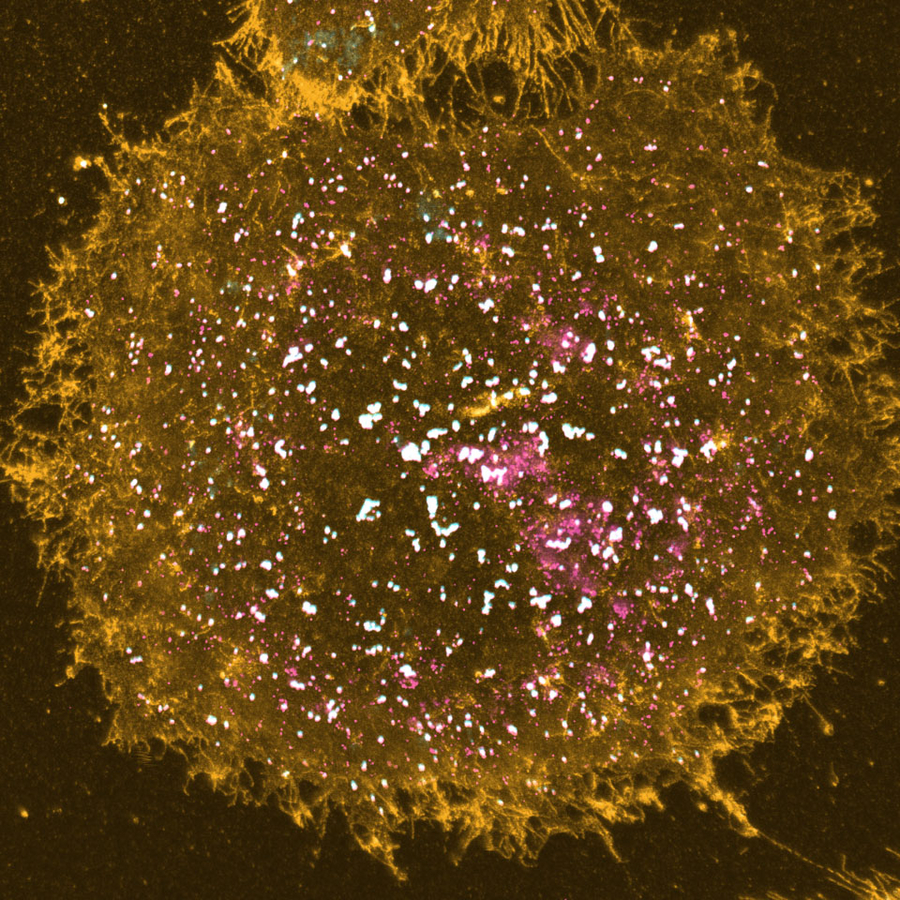
STED microscopy image of the membrane of a human melanoma cell, showing the bifunctional membrane lipids in orange. © H. Mathilda Lennartz et al. / MPI-CBG / Nat Cell Biol (2026)
Clathrin-mediated endocytosis is a major transport route for proteins into the cell. During this cellular process, cells internalize extracellular molecules through invagination of the plasma membrane and budding of very small vesicles (about 100nm in diameter), a process that is mediated by the protein clathrin. Proteins can be selectively shuttled by this transport route in order for them to reach their correct destination within the cell. However, it remains an open question if lipids are similarly sorted.
To find this out, researchers from the Max Planck Institute of Molecular Cell Biology and Genetics (MPI-CBG), the Biotechnology Center of the TU Dresden (BIOTEC) and the Center for Systems Biology Dresden (CSBD) teamed up. In their study, published in Nature Cell Biology, they combined super-resolution stimulated emission depletion (STED) imaging of bifunctional membrane lipids with mathematical modeling. STED microscopy is a fluorescence microscopy technique that overcomes the diffraction limit of light microscopy and creates super-resolution images by deactivating selected fluorophores. Bifunctional lipids (lipids that carry two chemical modifications) are tools to visualize lipids within cells by microscopy techniques such as STED.
The first author of the study, Mathilda Lennartz, a former postdoc in the group of André Nadler at MPI-CBG, says,
We looked at ten different lipid species and compared their uptake by clathrin-mediated endocytosis. Some of the lipids were slightly more selected to be transported into the cell than others. We found that this effect was mostly due to the way lipids are arranged in the membrane. Some lipids prefer to face the inside of the cell whereas others accumulate on the outside. This asymmetry together with the shape of the plasma membrane invaginations ultimately causes a small uptake preference for lipids facing the inner side of the membrane.
The supervising authors, André Nadler and Alf Honigmann (BIOTEC), explain the finding,
We observed that the amount of lipids transported is determined by their asymmetric distribution in the membrane. However, the differences in uptake we measured for different lipids are still very small. We therefore think the cell actually uses clathrin-mediated endocytosis to mainly sort proteins rather than lipids, while lipids are sorted by pathways such as non-vesicular transport routes. This allows the cell to separate two processes that are already logistically very complicated: the sorting of proteins and the sorting of lipids.
This new method to quantify lipids in complex cell structures and combine super-resolution STED imaging and mathematical modeling will help scientists better understand how membranes are organized and how lipids move throughout the cell.
H. Mathilda Lennartz, Susana da Costa Nunes, Kristin Böhlig, Aditya Chhatre, Radek Šachl, Sascha M. Kuhn, Lior Moneta, Pavel Barahtjan, Wan Yee Yau, Juan M. Iglesias-Artola, Martin Hof, Lukáš Opálka, Carl D. Modes, Alf Honigmann, and André Nadler: Quantification of lipid sorting during clathrin-mediated endocytosis. Nat Cell Biol (2026), doi: 10.1038/s41556-026-02068-7