
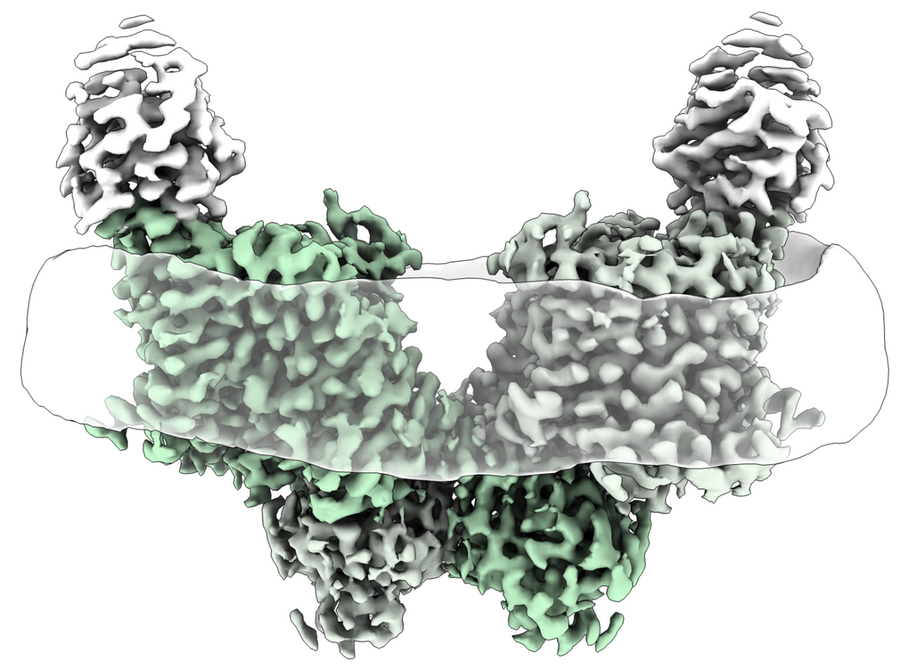
Cryo-EM reconstruction of the human SLC26A11 dimer (green, light green) embedded in a nanodisc (transparent) and in complex with a single domain antibody (white). © Benedikt Kuhn, 2026 / MPI-CBG
Proteins are powerful miniature tools inside our cells that have one single function just like the tools stowed away in our sheds. A hammer is for hammering; likewise, a transport protein is for transporting. However, a recent study by a team of researchers from the Max-Planck-Institute of Molecular Cell Biology and Genetics (MPI-CBG), the Hannover Medical School (MHH), the Forschungszentrum Jülich, and the University of Würzburg, published in Nature Communications, found that the protein SLC26A11 can actually perform more than one function. Depending on the situation, its role changes.
SLC26A11 is mostly located in the recycling centers inside our cells, small compartments called lysosomes, which allow the cell to stay healthy and functional. Inside lysosomes, old or redundant cell components are broken down into their building blocks, which are then transported out of the lysosome and reused. A failure in this recycling process leads to the accumulation of compounds to toxic levels, causing lysosomal storage diseases. The protein that clears lysosomes from the building block sulfate is the membrane protein SLC26A11. This protein is found in essentially every cell of our body. In previous studies, SLC26A11 was either understood as a transporter or as a channel. While both modes allow the passage of ions over membranes, their mechanism is as different as revolving and sliding doors. The current study was now able to show that both functions are mechanistically related.
While the transport function is crucial for sulfate recycling from the lysosome, the relevance of the channel function in the lysosome is unclear: it allows the passage of chloride ions only, and the lysosomal membrane already contains other chloride channels. However, the channel function does play a relevant role for small fractions of SLC26A11 proteins that are located in the plasma membrane, the membrane that outlines the cell. These proteins are essentially inactive, as SLC26A11 is only active in an acidic environment like the lysosome. But acidic conditions can also arise as a result of brain injury, e.g., a stroke. Under these stressful conditions, SLC26A11, located in the plasma membrane, switches into full channel mode, letting chloride rush into brain cells. This accumulation of chloride ions inside cells can result in water influx, causing pathological brain swelling (edema).
Benedict Kuhn, lead author of the study and former postdoctoral researcher in the group of Eric Geertsma at MPI-CBG, summarizes:
Our findings resolve the contradiction between the transporter and channel properties of SLC26A11 and show that one protein can actually do both. The physiological relevance of each mode depends on the environment. Our discovery highlights that proteins are not one-trick ponies but can act as molecular multitools.
The new dual function discovery could contribute to a molecular understanding of pathological brain swelling and could help develop new treatments, such as drugs or antibodies that block chloride influx. Furthermore, the discovery could also help to develop novel treatments for lysosomal storage disorders.
Kuhn, B.T., Kovermann, P., Haddad, B.G. et al. SLC26A11 is an atypical solute carrier with dual transport-channel function mediating lysosomal sulfate transport. Nat Commun 17, 7407 (2026). https://doi.org/10.1038/s41467-026-75749-4
SLC26A11: one protein, two functions